A hub collecting Presswork's work on disaster and hazard coverage: hurricanes, official accounts, contested claims and how verification holds up afterwards.
4 reports on file in this section / edition of Sept. 16, 2026
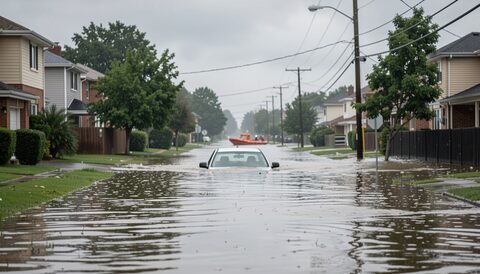
A COASTAL STREET AFTER THE STORM, FALLEN BRANCHES AND A BOARDED SHOPFRONT / ILLUSTRATION, AI-GENERATED FOR PRESSWORK
The Proof Bar: how each coverage stands
Every report on this site reads a text an outlet published. The bar sorts those reports by the state of the record: still standing as published, corrected by the outlet, or showing something the outlet never printed. The same status appears in the three entry list at the head of each report, so the bar and the report cannot disagree.
RUN AS PUBLISHED
The article reads a text the outlet published, and the record shows no correction attached to it.
The Presswork home page lists disasters among the beats this magazine watches, and the discipline it applies to a hurricane or an earthquake is the same discipline it applies to a city council vote: hold the published record against what was later established. A hazard produces two texts, not one. The first arrives within hours and freezes an official account into headlines. The second arrives over months and quietly revises the death toll, the sequence of events, the warnings that were or were not issued. Readers who only ever see the first version never learn there was a contest at all.
This piece gathers what Presswork has published about that lag, and points to a federal agency whose newsroom publishes its own record of the same stories.
Why does a first draft of a disaster harden so fast?
Breaking coverage is built on a contradiction. Desks need a confirmed number before anyone can confirm it, so they attribute to officials, and attribution does the work that verification cannot yet do. The phrase "officials said" is not a fact claim, it is a sourcing claim, and it survives editing precisely because it looks careful. Hours later the number moves and the sentence that carried it has already been shared, screenshotted and quoted back.
Presswork has followed this pattern in the New Orleans flood coverage, where the official account and the reported account diverged and the divergence itself became the story. The lesson there was not that reporters were lazy. It was that a single sourcing line, repeated across hundreds of outlets in the same afternoon, reads to an audience as consensus. Nothing in the copy signals that the count is provisional.
The revision, when it comes, rarely gets the same distribution. Corrections travel through the outlets that made the error and stop there. The reader who saw the first version often never sees the second.
The gap between a warning and a record
Hazards have a documentary spine that politics does not. There are advisories, gauge readings, evacuation orders, timestamps on emergency alerts, and after the event there are engineering reports that reconstruct what the structures did and when. Those documents are dull, and dull is an advantage: they do not perform certainty they do not have.
The trouble is that the documentary record is published slowly, while the narrative record is published instantly. A newsroom working the first night has phone calls and press conferences. It does not have the sensor log. So the first account is built from testimony, and testimony under stress is unreliable in predictable ways: people compress time, they misremember the order of events, they fill gaps with what they assumed happened.
Presswork's hurricane coverage file makes the point that the official account is a genre, not a verdict. It is written to be acted on, which means it errs toward over-warning, and it is written by people who will be blamed if it under-warns. Reporting that treats it as neutral description mistakes a safety instrument for a factual one.
What federal agencies publish about their own disasters
One useful counterweight is the running news output of the National Institute of Standards and Technology. The agency's news and events page collects its announcements and event notices in one place, from standards work to the findings of its investigations into building failures, fires and other hazardous events. For a reporter reconstructing a disaster months later, that is a place where the technical record surfaces on its own schedule, with the agency's own language attached.
It is not breaking news. It does not compete with a scanner. Its value is different: it is the same institution speaking later, in technical terms, about events the first coverage handled in fragments. When the record changes, the change has a home.
How do newsrooms handle claims that refuse to settle?
Some hazard stories never converge. A structural collapse, a power outage, a weather event with an unusual signature will attract explanations that outlive the investigation. Presswork has examined how newsrooms handle the 9/11 conspiracy claims and the weather modification claims around Hurricane Sandy, and the two cases fail in opposite directions.
In the first, the problem was exposure: claims got airtime because they were loud and because a debate format rewards two sides regardless of evidence. In the second, the problem was dismissal: the claims were absurd enough that some desks treated the underlying question, what the meteorological record actually shows, as not worth covering. Both are failures of the same kind. Neither treats the claim as something to be checked and closed.
A workable rule is unglamorous. State what is documented. State what is not. State who would have to be lying for the alternative to hold, and whether that many people could keep it quiet. Then stop. What must not happen is a headline that leaves the question open when the record is closed, or a headline that closes a question the record has not answered.
The numbers that move after the deadline
Counts are the most revised facts in any disaster story, and they are the ones most likely to be pinned to a headline. Casualties get recounted as bodies are identified. Damage estimates get replaced as assessments are completed. Evacuation figures get corrected when the same household is counted twice.
What the first coverage reports
What the later record tends to show
A casualty figure attributed to officials
A revised figure, sometimes higher, sometimes lower
A cause stated as suspected
A cause stated after investigation, or still undetermined
A warning described as timely or late
A timeline reconstructed from logs and alerts
A damage total in currency
A reassessed total, or a range
None of these revisions is scandalous. They are the ordinary cost of reporting an event while it is still moving. What is scandalous is when a newsroom revises silently, with no note, so that the archive keeps the wrong version and the reader has no way to know the ground shifted.
Outages, cables and the hazards that leave no rubble
Not every hazard has a visible site. An undersea cable cut or a wide area network failure is a disaster with no wreckage to photograph, and Presswork's file on cable cuts and outage coverage shows how thin the reporting gets when there is nothing to stand in front of. An outage produces speculation about cause before any operator has said anything, and the speculation travels because a map of red dots is easy to share.
The verification problem is the same as in a flood, only faster. Who is the authoritative source for a network outage? Often a private operator with commercial reasons to describe the failure narrowly, and no obligation to publish in public. The reporting then rests on statements that cannot be checked against anything, which is exactly the condition hazard coverage is supposed to guard against.
What to watch in a hazard story as it develops
Four markers separate coverage that will hold up from coverage that will not. First, whether a number is attributed to a source that will still stand behind it in a week, or to "officials" with no institution named. Second, whether the copy distinguishes what is known from what is assumed, or blends the two into one declarative sentence. Third, whether the outlet has assigned anyone to the reconstruction, the weeks of engineering and records work that produce the durable account. Fourth, whether corrections get the same prominence as the errors they fix.
A newsroom that scores well on all four is not doing anything exotic. It is keeping the two texts, the instant one and the durable one, in the same place, and telling readers which is which.
Where the revision actually lands
The durable record of a hazard is assembled from sources that publish on their own schedules: investigation reports, sensor archives, emergency management logs, and the technical output of agencies that study what failed. The National Institute of Standards and Technology publishes one such stream, and its news and events page is the entry point to it. Reading it against the coverage of the same event, months apart, is the cheapest test available of whether the first account survived contact with the record.
Take one hazard you followed in real time. Pull the headlines from the first forty-eight hours. Then pull what the investigating body published a year later, from the agency's own page rather than from a summary of it. Compare the two, sentence by sentence. The exercise costs an evening and it changes how you read the next breaking number you see.
The Presswork editorial team / contact@media-criticism.com